
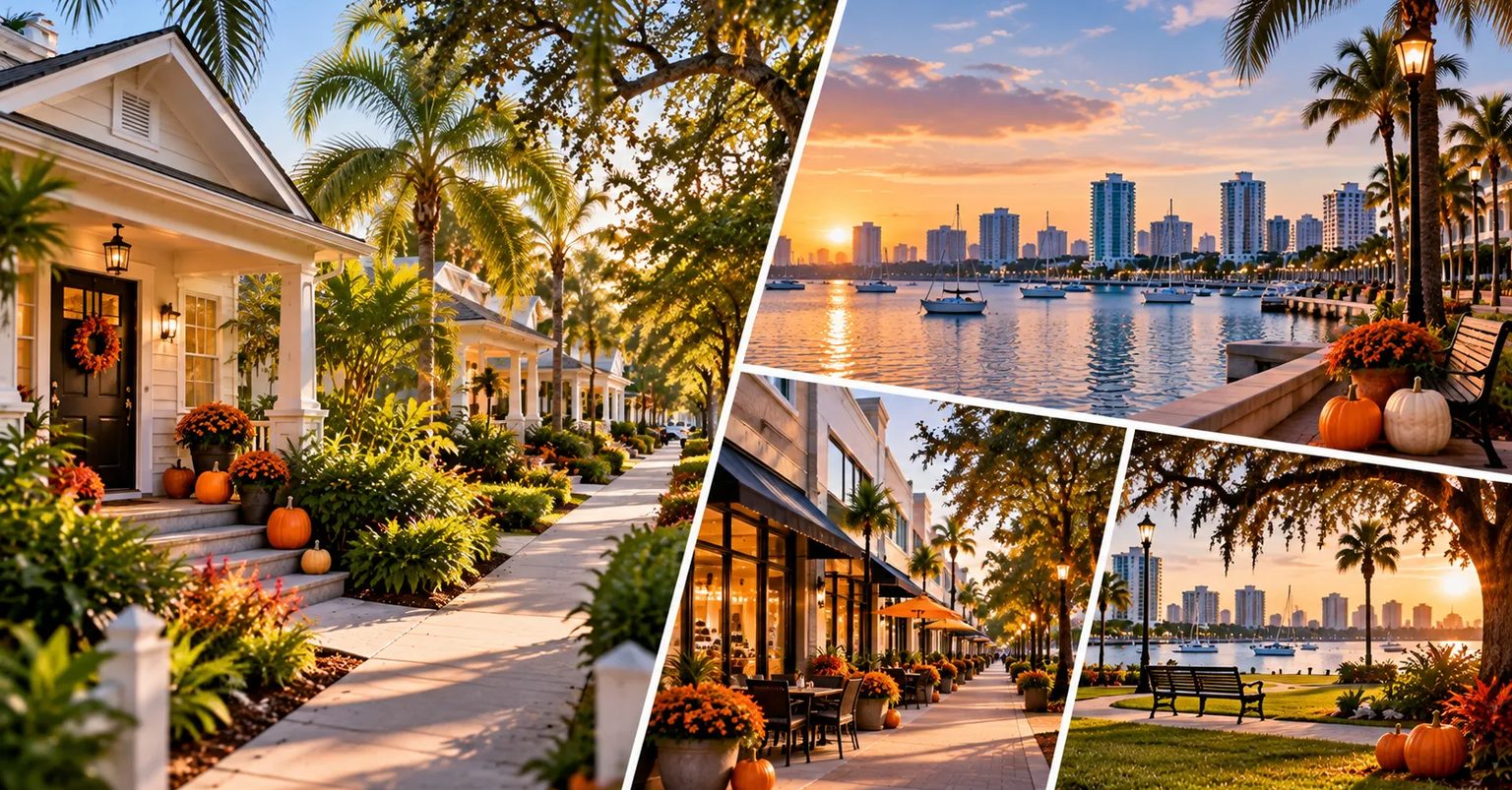
A house is a set of rooms you can measure. A neighborhood is everything that happens around those rooms once you live in them — the walk to coffee, the shade on the sidewalk in the afternoon, whether the street fills up on a Saturday or empties out. You can judge a house from twenty photos and a floor plan. You cannot judge a neighborhood that way, and almost nobody tries to until after they have moved in.
October is when that gets easy in St. Petersburg. The humidity lets go, the evenings turn usable, and the whole city moves back outside. Porches, sidewalks, parks and the markets come back to life after a long summer indoors. For the next few months, a neighborhood will show you what it actually is — which makes this the best stretch of the year to go and find out before you buy into it.
Why does October change what you can learn about a St. Petersburg neighborhood?
October changes things because people are outside again, and a neighborhood is only visible when its residents are using it. Through August, a St. Pete block at two in the afternoon tells you almost nothing — everyone is inside with the air conditioning on, and the street reads as empty no matter what it is like the rest of the year.
By late October that flips. Afternoon walks are comfortable. Patios fill up instead of sitting empty. Weekend markets and outdoor events start their cooler-weather schedules, and the parks along the water go from a place you drive past to a place you sit in. What you see on a street in October is much closer to the version of that street you will live with from fall through spring, which is most of the year here.
What should you notice on a ten-minute walk from the front door?
Walk ten minutes in each direction from the front door and write down what you reach, because that list is your daily life more than any feature on the listing. Ten minutes is roughly half a mile at an easy pace, and it is the distance most people will actually cover on foot without planning for it.
Look for the ordinary things first: coffee, groceries or a market, a park, a place to eat, somewhere to sit outdoors. Then look at how you get there. Is there a continuous sidewalk, or does it stop halfway down the block. Are there curb cuts and crossings at the busy street, or do you have to walk three blocks out of your way to cross it. Is there shade for most of the route, or none. In much of older St. Petersburg the answers are good, because the streets were laid out as a grid long before the car took over — short blocks, numbered avenues running east and west, streets running north and south, alleys behind the houses. Newer sections are often built around curves and cul-de-sacs instead, which is a different kind of street to live on, not a worse one. The point is to know which one you are buying.
Why walk the same block at different hours?
Because a single showing shows you one hour of a street’s week, and the hours are not alike. The block you see at eleven on a Tuesday can be a completely different place at six in the evening when everyone is home, or at eight on a Saturday morning, or after dark.
Go back at least three times if you can. A weekday morning tells you about traffic patterns and how the street handles morning traffic. A weekday evening tells you about parking — whether there is room at the curb once every household is home, and whether you would be hunting for a space after dinner. A weekend afternoon tells you how the street is actually used: whether people are out on porches and sidewalks, whether the park two blocks over is full or empty, whether the commercial street nearby draws a crowd that spills onto your block. None of those are things you can ask about and get a reliable answer. You have to be standing there.
What does the nearest commercial street tell you?
The nearest commercial street tells you what your week will look like, because it determines what you can do without getting in the car. Walk it end to end rather than driving past it.
Count the storefronts that are open, and notice what kind they are. A strip with a grocery, a hardware store, a pharmacy and a few places to eat supports an everyday routine. A strip that is mostly destination businesses is a nice evening out but it will not get you a gallon of milk. In St. Petersburg, Central Avenue runs most of the way across the city and changes character every several blocks, from the Grand Central District through downtown to the waterfront, so the stretch nearest the house matters far more than the street’s reputation as a whole. Look at the sidewalk width, the awnings, whether there are benches, whether the cafés put tables out. Those details tell you whether the street was built to be walked or to be parked in front of. Our St. Petersburg neighborhood guide breaks the city down this way, block by block, so you know which commercial streets serve which areas.
How do trees, shade and rain shape a block here?
Tree canopy and drainage shape a St. Pete block more than most buyers expect, and both are easy to read with your own eyes in October. Shade is the difference between a sidewalk you will use in May and one you will avoid. Broad live oaks, some of them draped in Spanish moss, cover whole streets in the older parts of the city; palms look the part but cast almost no shade at all. Stand on the sidewalk in the late afternoon and see which one you are dealing with.
Drainage is the other half. Walk the block after a hard rain if you get the chance — and in Florida you usually do. Note where the water goes: whether the street crowns and drains to the curb, whether there are swales or storm grates, whether anything is standing in the gutter an hour later. Then check the specifics for any address you are serious about, because they vary house to house. Elevation varies; check the FEMA flood map for any specific address. Your insurance quote will reflect that map, so it is worth knowing before you fall for a porch. Street trees, lot sizes and the way the older blocks were platted are part of why areas like the Historic Old Northeast feel so different from a newer subdivision a few miles away, even with similar houses on them.
Which St. Petersburg places are worth building into a neighborhood visit?
Build the visit around the places you would use on an ordinary week, not the ones you would take a visitor to. Start with the waterfront park system along Tampa Bay downtown — a nearly continuous run of public green space and seawall promenade, with the St. Pete Pier at the middle of it. It is the single easiest way to understand how the city relates to the water, and in October it is comfortable from morning until well after sunset.
Then add the everyday ones. The Saturday morning market downtown is back on its cooler-weather schedule, and it is as much a read on who is out and about as it is a grocery run. If you are looking at a house near a park, go sit in that park. Crescent Lake has a loop around the water that the surrounding blocks treat as their front yard, and Boyd Hill Nature Preserve on the south side is a different scale of green space again. Ride or walk a stretch of the Pinellas Trail if biking is part of how you get around. And if a boat is in the plan, spend an afternoon at the water and look at the access, the dockage and how far you are from open bay — that is a neighborhood attribute here as much as the sidewalks are.
How do you turn all of this into a decision?
You turn it into a decision by writing it down while you are standing there, and comparing neighborhoods on the same list. Memory flattens everything after the third showing, and by the fifth you will have merged two streets into one.
Keep it to the things you can verify with your own eyes: what is inside the ten-minute walk, how the sidewalks and crossings hold up, what the commercial street supports, how much shade the block has, where the water goes after rain, how the street looks on a weekday evening versus a Saturday. Score each neighborhood on those and the right answer usually separates itself from the rest without much argument. If you are new to the area, our relocation guide and buyers page cover how this fits into the rest of the process — financing, touring, offers and closing — so the neighborhood work does not happen in isolation.
Frequently Asked Questions About St. Petersburg Neighborhoods
When is the best time of year to visit a St. Petersburg neighborhood before buying? |
October through spring, and October is the natural starting point. The humidity breaks, afternoons and evenings are comfortable to be outside in, and outdoor markets and events come back onto their cooler-weather schedules. People are using their streets, sidewalks and parks again, so what you observe is close to what you will live with for most of the year. |
What should I look for on a walk around a neighborhood I am considering? |
Look at what you can reach on foot in about ten minutes and how you get there — continuous sidewalks, crossings at the busy streets, shade along the route. Then look at the block itself: lot sizes, home styles, tree canopy, how cars park in the evening, and what the nearest commercial street actually supports day to day. |
How many times should I visit a neighborhood before making an offer? |
At least three, at different hours. A weekday morning shows you traffic and commute patterns, a weekday evening shows you parking once everyone is home, and a weekend afternoon shows you how the street and the nearby parks and shops are really used. One showing only shows you one hour of the week. |
Does St. Petersburg have walkable neighborhoods? |
Many of the older sections of the city were platted as a grid with short blocks, sidewalks and rear alleys, which makes walking straightforward, and Central Avenue and the downtown waterfront parks are reachable on foot from a number of them. Newer sections are generally laid out with curving streets and cul-de-sacs, where more trips are made by car. Both exist here, so it is worth deciding which layout you want. |
How do I find out about flooding and elevation for a specific address? |
Elevation varies; check the FEMA flood map for any specific address. Drainage also differs block to block, so it helps to see how the street handles water after a hard rain and to get an insurance quote early, since the quote reflects the flood map for that exact property rather than the neighborhood as a whole. |
Spend an October Afternoon in a Neighborhood With Us
We live and work here, and the fastest way to answer “could I live on this street” is to walk it together. If you would like to see two or three neighborhoods side by side — on a weekday, on a weekend, or both — call Ken and Christina at (727) 219-9620, or send us a note through our contact page and we will set up a time that suits you.
Ken Lenoir & Christina Luciana, Keller Williams St. Pete